A perimenopause sleep workbook + private companion app
For the 3 AM wake‑ups no one warned you about.
A 21-night workbook for women in perimenopause who fall asleep fine — then wake between 2 and 4 AM. Ten minutes each evening, a four-step plan for the moment you wake, and a private diary that does the math. Every claim sourced.
$27 once · no subscription · instant download
Awake right now? Open the free 3 AM page — dark screen, no sign-up.
Built for staying asleep, not just falling asleep · Every claim sourced · A private diary that stays on your phone · A one-page summary for your doctor · No supplements, ever
- 46-page PDF · Letter, A4, fillable
- Companion app
- Your data stays on your device
- No supplements

Sound familiar?
Every night, the same small hours.
- 10:45 PM
You fall asleep without much trouble.
- 3:07 AM
Wide awake. Warm. Heart a little fast.
- 3:40 AM
Tomorrow’s to-do list, last week’s conversation, a worry from 2009.
- 4:30 AM
You check the clock and do the math: “If I fall asleep now…”
- 2:00 PM
Exhausted. And somehow wired again by bedtime.
You’re not bad at sleeping. Your nights are changing — and there’s a lot you can practice.
Sound familiar?
Check the ones that sound like you.
Not a test or a diagnosis — just a way to notice your pattern. Loud snoring, gasping or pauses in breathing at night? That’s a separate thing worth checking with your doctor.
Why it happens
Three things are usually going on at 3 AM.
Hormone swings & night heat
In perimenopause, hormone levels rise and fall unpredictably, and hot flashes or night sweats can wake you — though sleep-lab studies suggest some wakings happen without one.5
A lighter second half
By 3 AM you’ve used up much of your “sleep pressure,” and your body’s early-morning wake signals are rising. It takes less to tip you into wakefulness.
The worry layer
You wake, then worry about being awake. Clock-watching and trying hard to sleep keep the body on alert.6 This is the part practice can change most.
What helps — the evidence
This isn’t a new idea. It’s the approach sleep guidelines put first.
#1
Recommended first
The American College of Physicians recommends cognitive behavioral therapy for insomnia (CBT-I) as the first treatment for chronic insomnia, and the American Academy of Sleep Medicine gives it a strong recommendation.1,2
≈2×
Studied in women like you
In a trial with 106 women in peri- and postmenopause who had insomnia and hot flashes, CBT-I cut insomnia scores by about twice as much as menopause education alone (−9.9 vs −4.7 points).3
10 trials
Self-help versions work too
Across 10 randomized trials with about 1,000 people, self-help CBT-I from books or programs improved sleep efficiency and time awake at night, and the gains held. Effects are smaller than with a therapist.12
Honest limit: these studies tested the methods, not this workbook. Our workbook hasn’t been tested in a trial. It teaches the self-guided parts of the approach and helps you take the rest to your doctor. See the research in charts · Read the studies and who published them.
The method
Not more sleep tips. A plan for the moment you wake.
CBT-I (cognitive behavioral therapy for insomnia) works on what keeps insomnia going, not just on bedtime. In a randomized trial of peri- and postmenopausal women with insomnia and hot flashes, CBT-I delivered by phone with a trained coach improved insomnia more than menopause education.3 In another trial of postmenopausal women with chronic insomnia, clinician-led CBT-I and sleep restriction both outperformed sleep-hygiene advice.4
Those studies tested clinician-led programs. This self-guided workbook hasn’t been tested in a trial — we tell you exactly what it draws on, and you can check every source below.
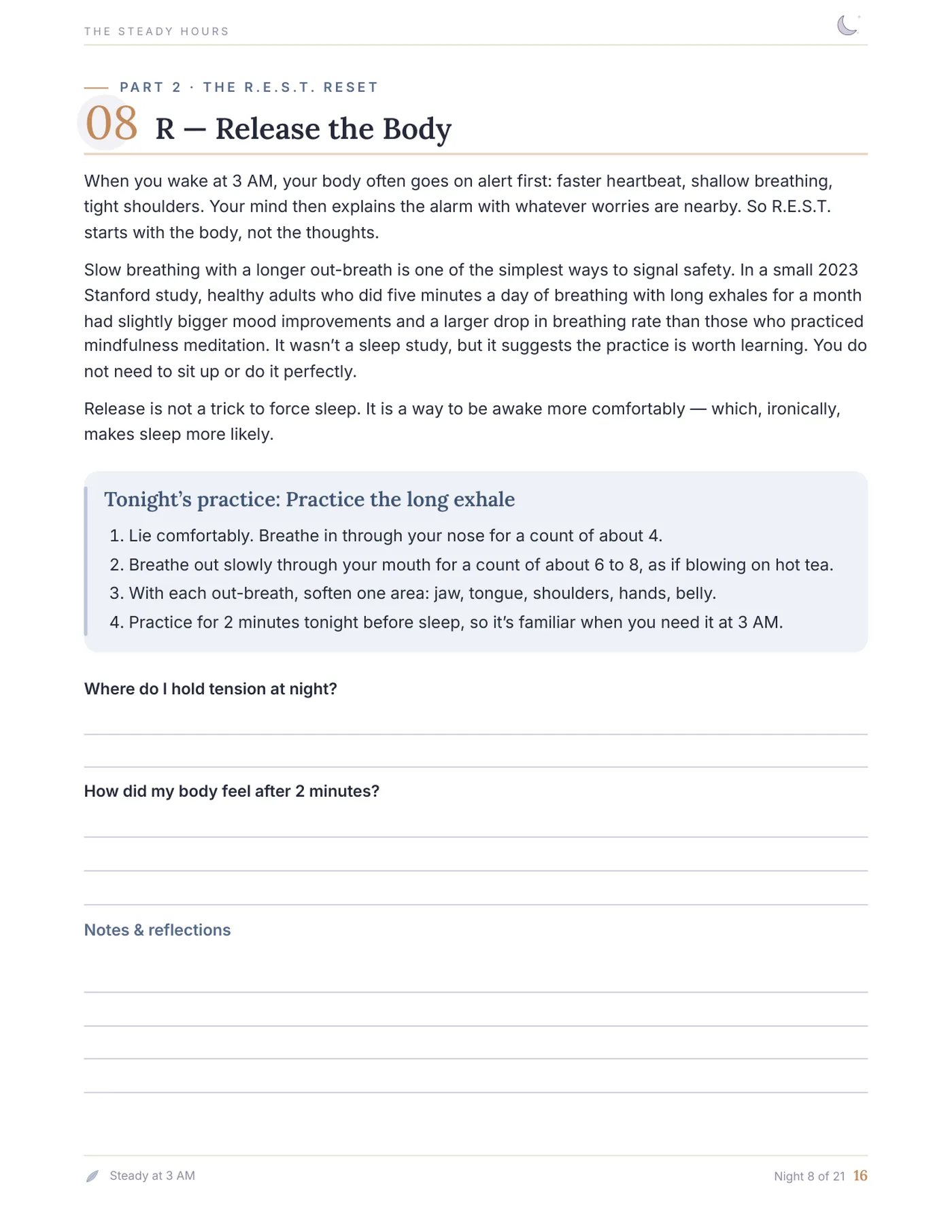
Release the body
Two minutes of long, slow breaths out — before anything else.
Ease the thoughts
“3 AM thoughts are not 9 AM facts.” Park them on paper.
Step out if wide awake
Break the link between your bed and lying awake.
Try again when sleepy
Back to bed with heavy eyes — and protect tomorrow night.
Look inside
21 short evenings. 3 parts. 9 bonuses.
Part 1 · Understand your nights — why 3 AM, your anchor wake-up time, the wired-and-tired loop, no more clock-watching, a wind-down hour.
Part 2 · The R.E.S.T. reset — one step at a time, then your bedside card.
Part 3 · Calmer days, steadier nights — light, caffeine and alcohol (honestly), heat at night, the worry window, the sleep story, talking to your doctor.
- 46 pages
- 21 nights × ~10 min
- US Letter + A4 + fillable
- Sources listed

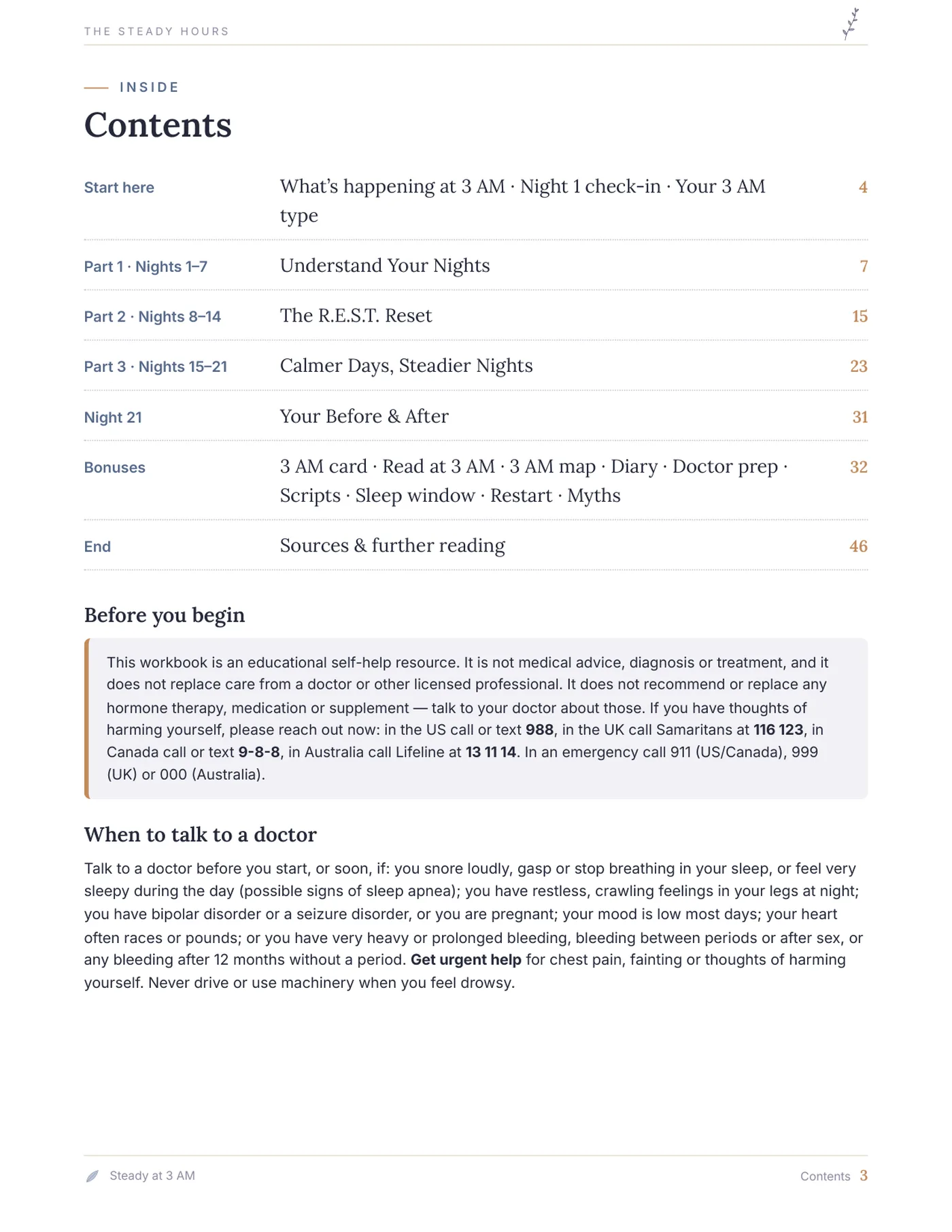
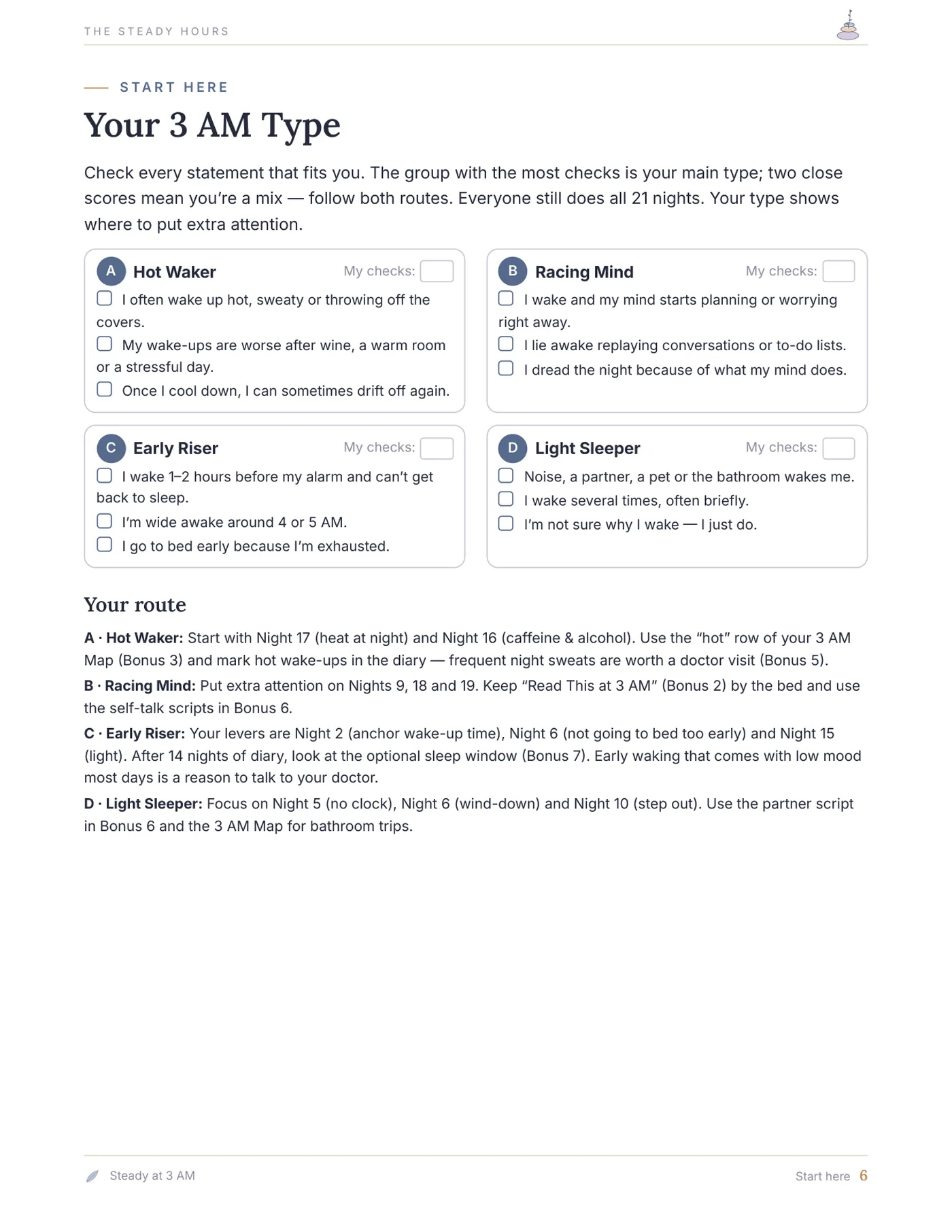
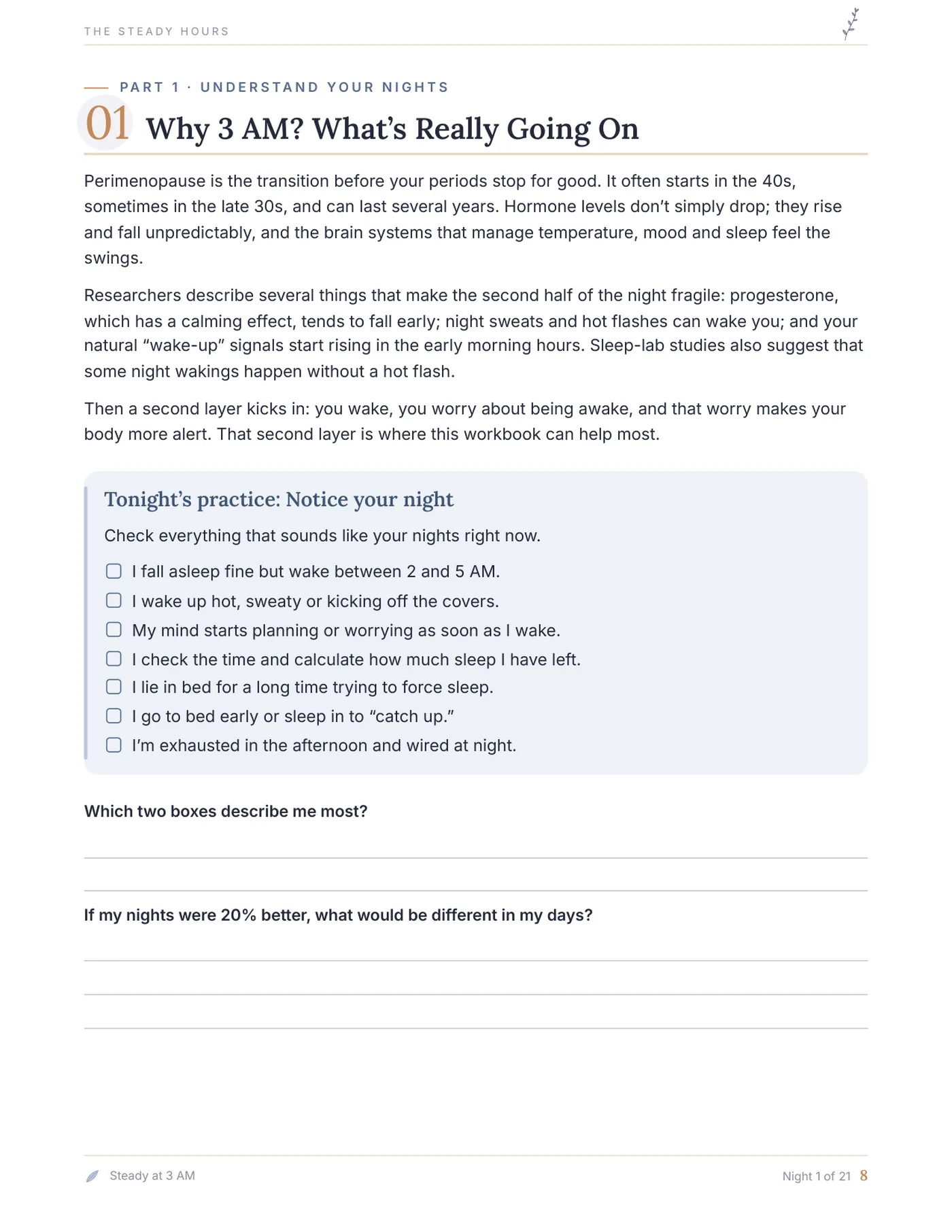
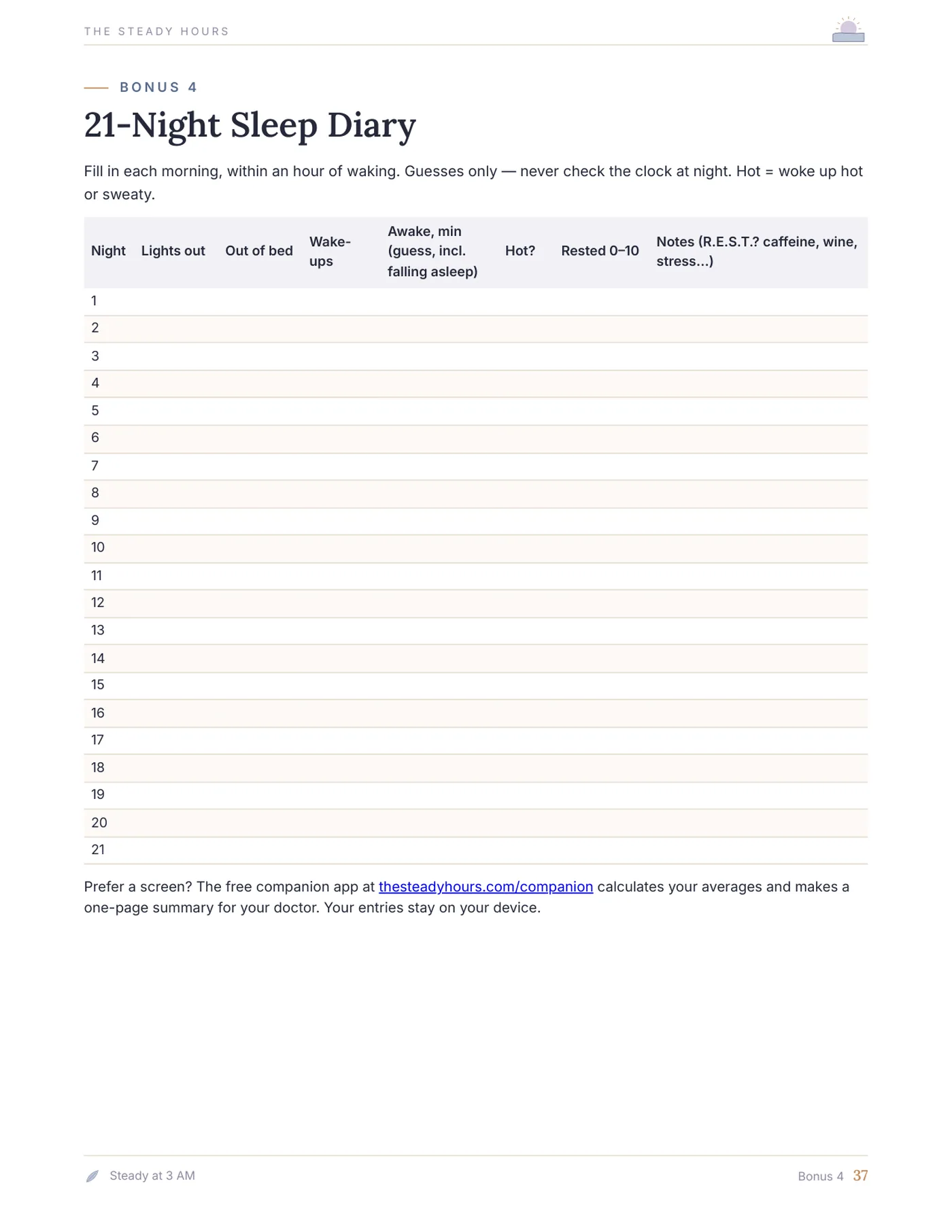
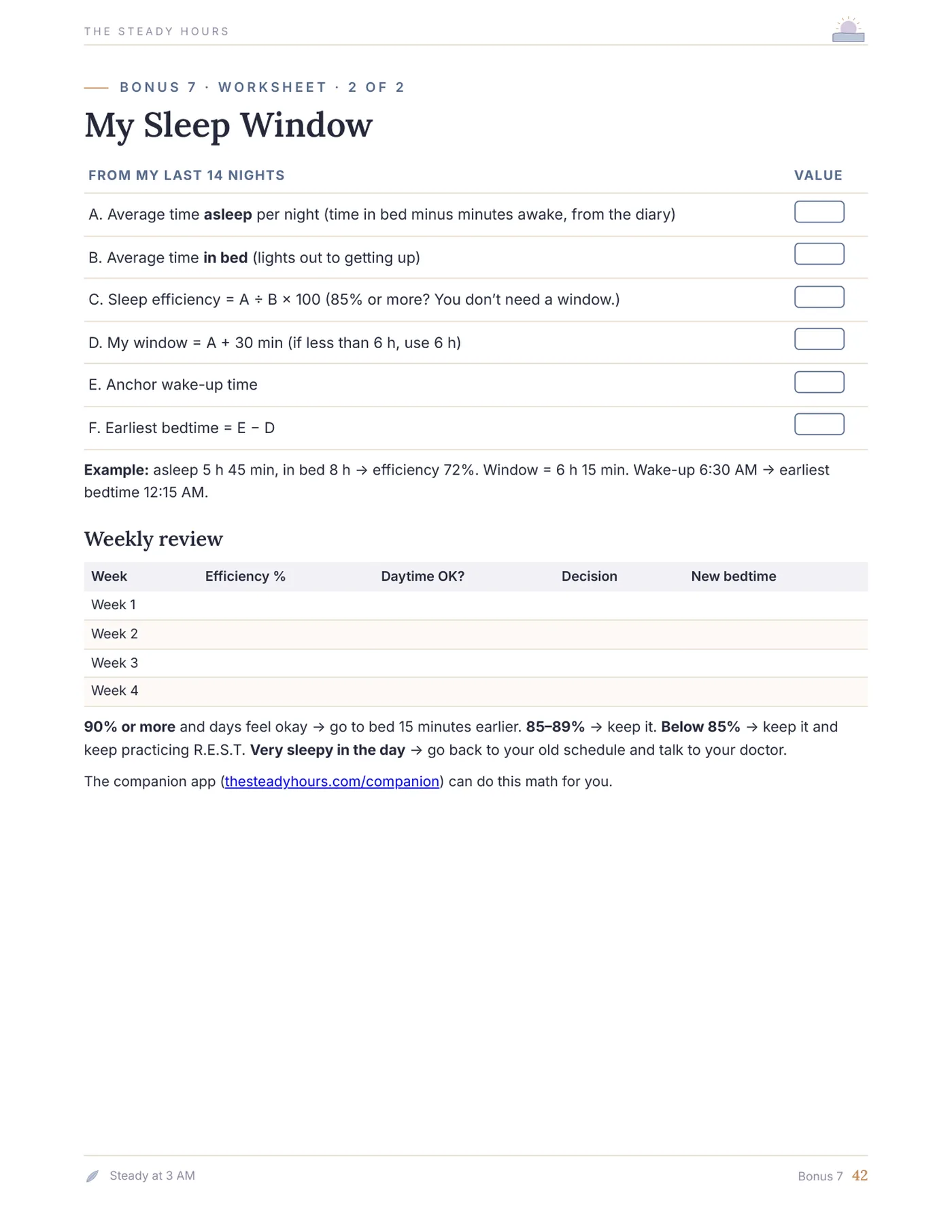
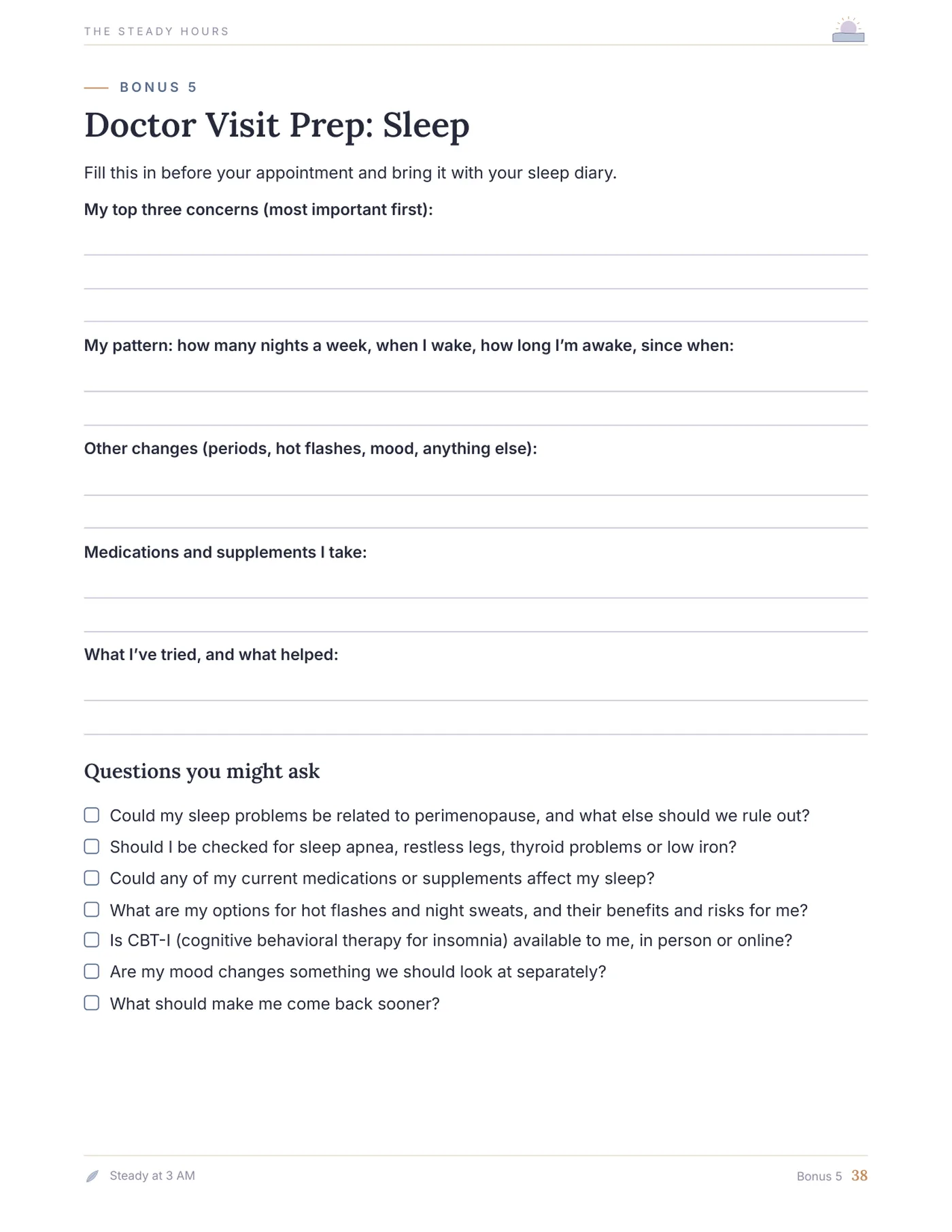
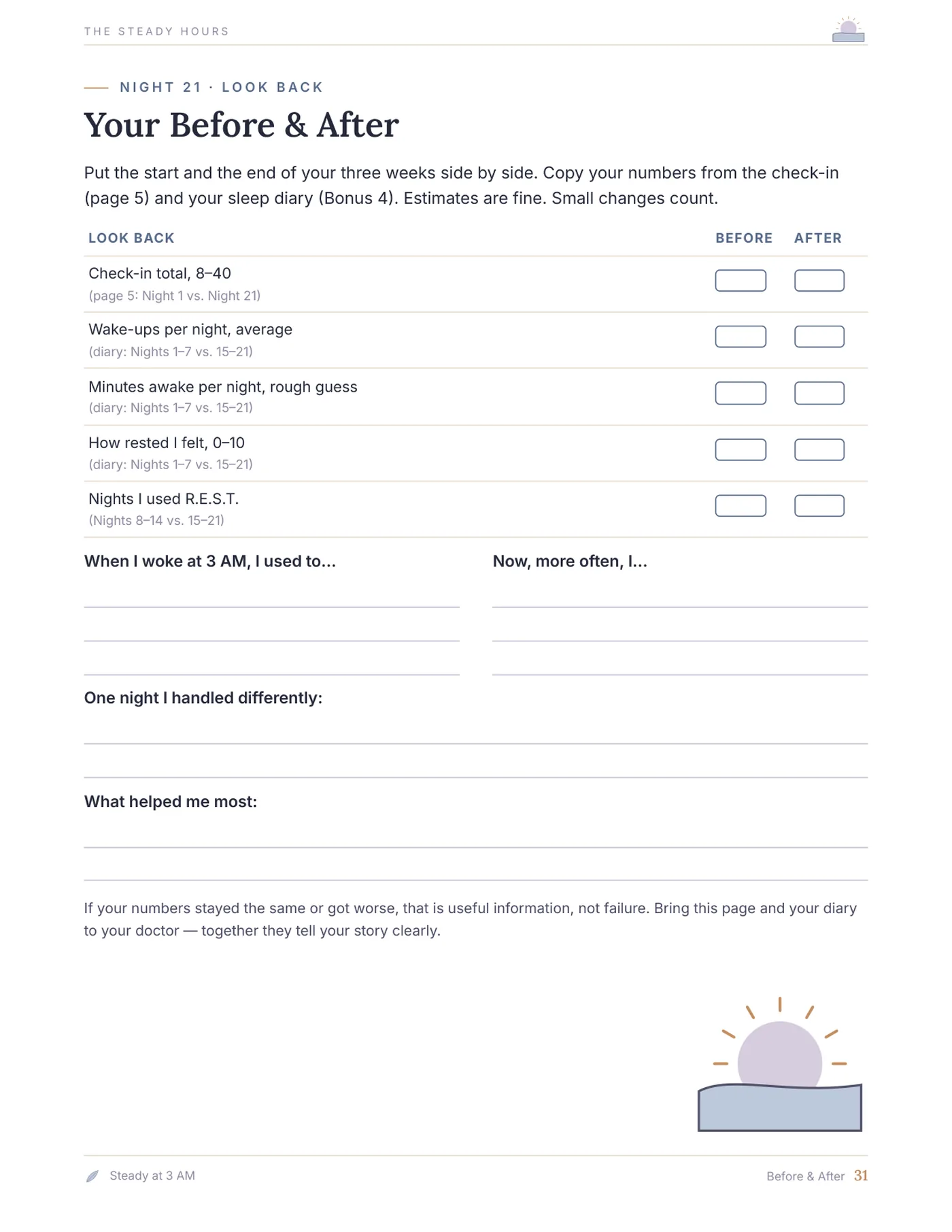
Scroll sideways to see more pages. Tap a page to open it larger.
It’s 3:07 AM — try the tools
A diary app that does the math for you.
Lots of sleep products include a tracker. This one calculates: your sleep efficiency, week 1 against your latest week, the optional sleep window, and a one-page summary for your doctor. It comes with the workbook — two of its tools work right here.
How solid is your sleep?
Sleep efficiency = time asleep ÷ time in bed.
Step one of R.E.S.T.
Breathe in for 4, out for 6. Practice in the evening so it’s familiar at night.
A one-page summary for your doctor
Log last night in two minutes each morning. The app calculates your averages, compares your first and latest weeks, helps with the optional sleep window and prints a summary for your appointment.
- Saved only in your browser — no account, nothing sent to us
- Back up or delete your data any time
- Gently reminds you to put the phone away at night

What a week can look like
Maya, 47 — her first week with the diary.
This shows how the plan and the diary are used: what you write down, what you try, what you notice.
| Night | Diary | What she tried / noticed |
|---|---|---|
| Mon | Lights out 10:40 · woke 3:05 · awake ~70 min | Doing the math again. Used R: long breaths out. |
| Tue | Lights out 10:30 · woke 3:15 · awake ~60 min | Hot, kicked covers off. Turned the clock to the wall. |
| Wed | Lights out 10:45 · woke 2:55 · awake ~45 min | Wide awake after 20 min — got up, armchair, paper book. |
| Thu | Lights out 10:40 · woke 3:10 · awake ~50 min | Two glasses of wine at dinner. Note for the pattern page. |
| Fri | Lights out 10:50 · woke 4:30 (bathroom) | Back to bed without the phone. |
| Sat | Got up at 6:30 anyway | Anchor wake-up time — hardest one. |
| Sun | Weekly look | Wakes cluster 2:55–3:15. Worse after wine. Writing both on the doctor sheet. |
Illustrative example — not a real customer, and not a promised result. Everyone’s nights are different; many people need the full three weeks before they see a pattern change.
Everything you get
One payment. All of this is yours.
- The 46-page workbook — 21 evenings, about 10 minutes each — Letter, A4 and fillable.
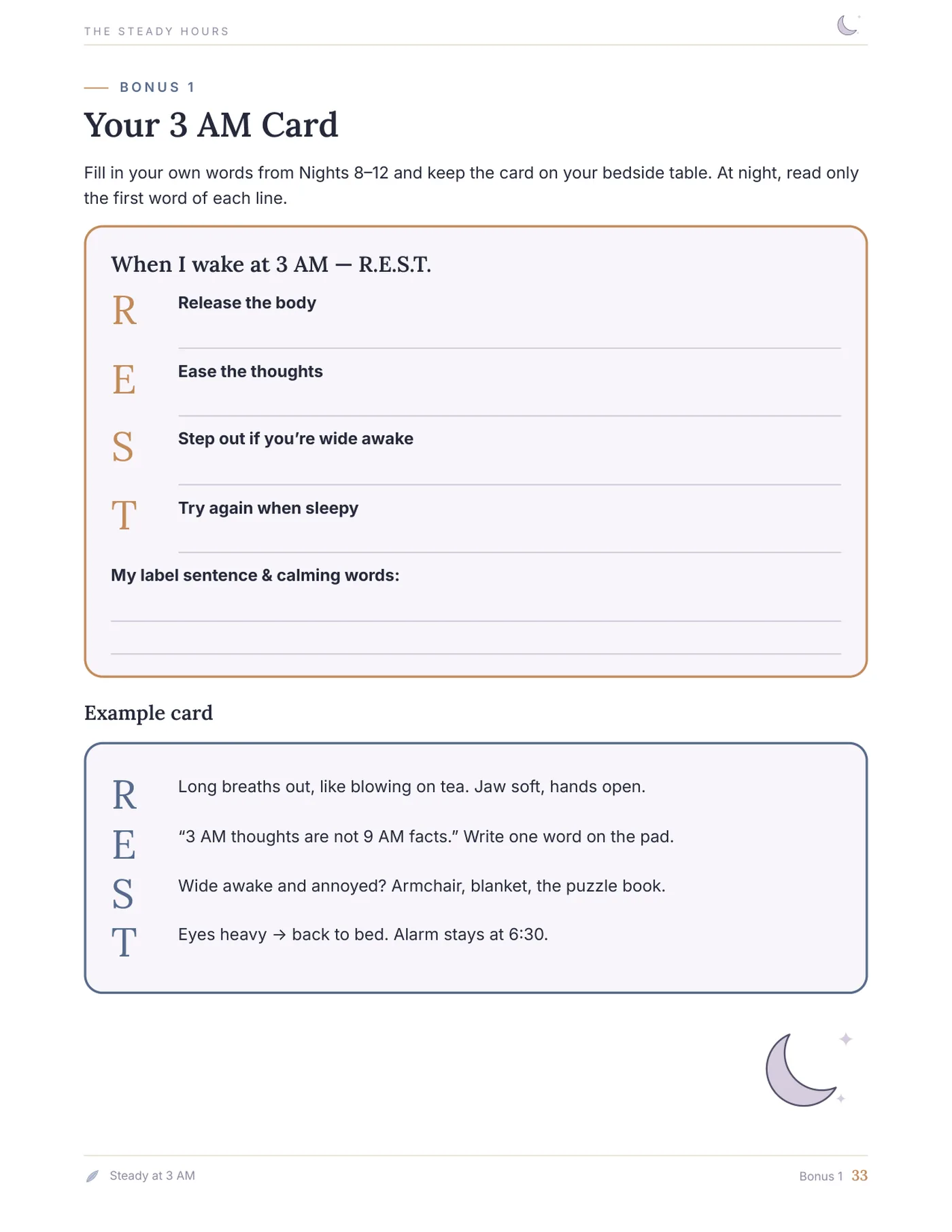
- The R.E.S.T. plan for 3 AM — Four steps for the moment you wake, plus a bedside card and cut-outs.
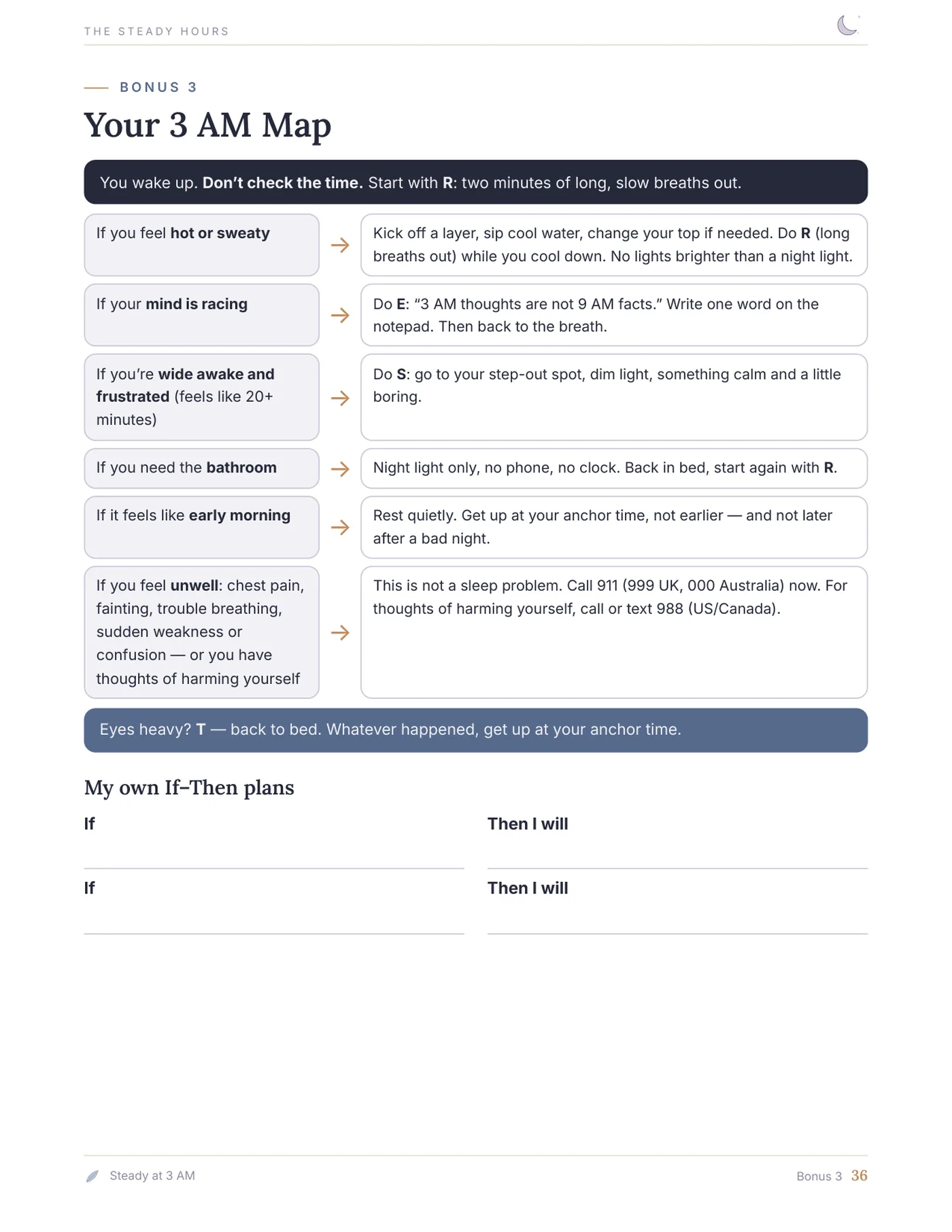
- Your 3 AM type and map — A route through the workbook for how you wake: hot, racing mind, early, light.
- A gentle sleep window (optional) — For later in the plan: never less than 6 hours in bed, it only grows or stays the same, and it starts with a clear list of who should check with a doctor first.
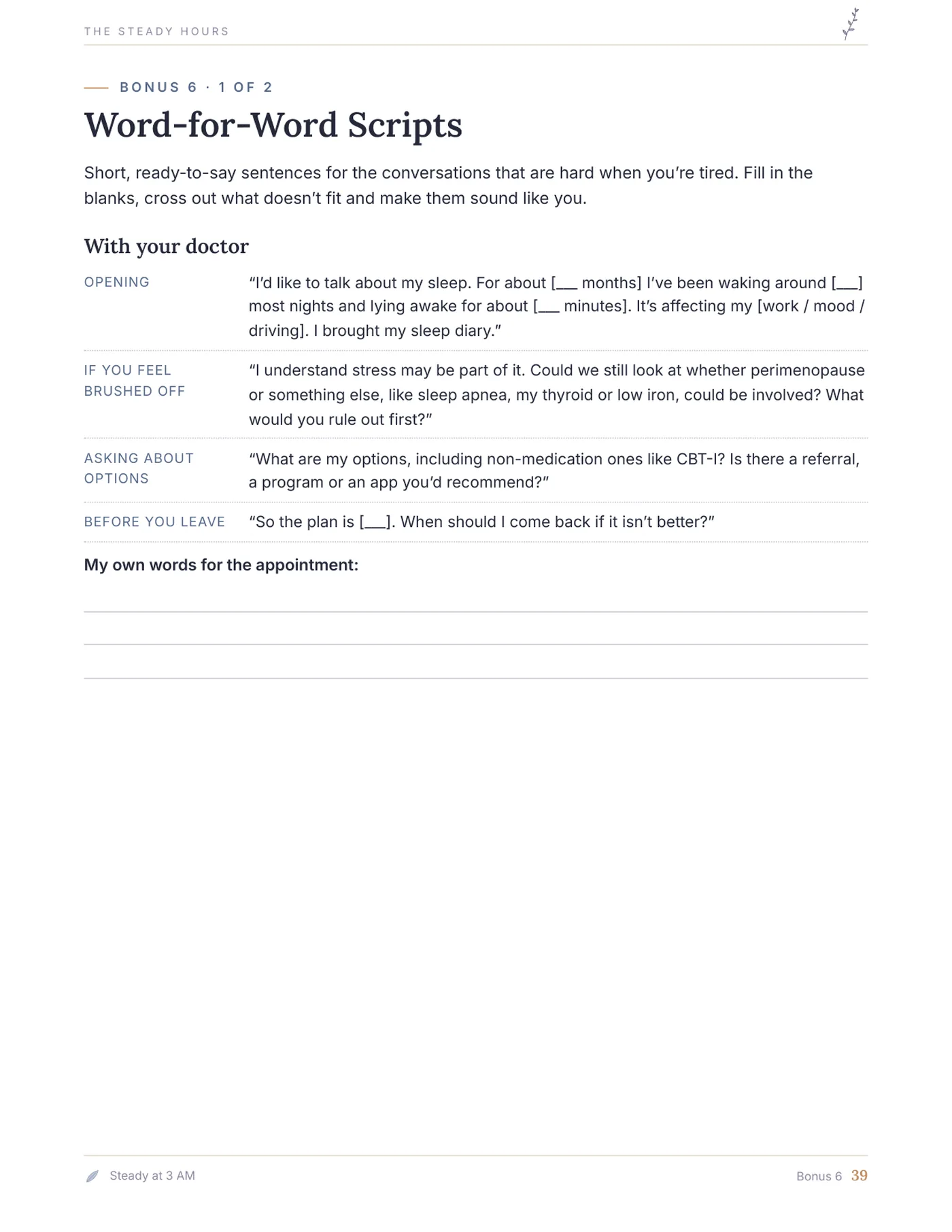
- Doctor kit — Prep sheet, word-for-word scripts and a one-page summary from your diary.
- The companion app — Private sleep diary that does the math, breathing pacer, worry-window timer, hot-flash log. Dark at night, works offline — and your diary stays on your device unless you export it.
- 9 bonuses — 21-night diary, “Read this at 3 AM”, gentle sleep window, 3-evening restart plan, myths, scripts for your partner and boss…
- Steady Extras: five one-page helpers — For your partner, for work after a bad night, a symptom timeline for your doctor, clock changes and travel, and the bad-night reset.
- Start Here guide + free updates — Every future version of the workbook, free.
No subscription, no supplements, no upsell you have to say no to. $27 once.
What you get
Everything for the night — and the appointment.
- The workbook (46 pages) in three files: US Letter, A4 and fillable. 21 evening practices, about 10 minutes each.
- Your 3 AM type with a route through the workbook for it.
- The R.E.S.T. plan, a bedside 3 AM card, cut-out cards and a one-page 3 AM map (if hot, if racing mind, if wide awake…).
- For your doctor: a prep sheet, word-for-word scripts and a 21-night sleep diary.
- 9 bonuses:
- Bedside 3 AM card + cut-out cards
- “Read this at 3 AM” page
- Your 3 AM map
- 21-night sleep diary
- Doctor visit prep sheet
- Word-for-word scripts (for your doctor, your partner, your boss)
- Gentle sleep window (optional, with safety limits)
- 3-evening restart plan
- Myths that keep you awake
- Steady Extras: five one-page helpers — for your partner, for work after a bad night, a symptom timeline for your doctor, clock changes and travel, and the bad-night reset.
- The companion app: private sleep diary with automatic math, sleep-window helper, breathing pacer, worry-window timer and one-click doctor summary.
- Night 1 and Night 21 check-ins, side by side.
Steady at 3 AM
$27one payment · no subscription · no monthly bottles
Get instant access- Instant download, also emailed to you
- Secure checkout by Creem
- Faulty file? We fix it or refund you
Not sure yet? Read 7 free pages and try the app tools before you buy.
Choose what fits
One workbook, or nights and days together.
For 3 AM wake-ups
Steady at 3 AM
$27
- 46-page workbook, 21 nights
- Free companion app
- Doctor-visit pages
Nights + days
If hot flashes wake you too
Nights + Heat bundle
$44save $10
- Steady at 3 AM
- Steady Through the Heat: 4-week CBT workbook for hot flashes and night sweats
- Night-sweat card and a 4-week summary for your doctor
Prefer to listen in the dark? A short Night Audio Pack is being recorded — buyers will be able to add it for $7.
All options: one payment, instant download, secure checkout by Creem. Educational, not medical care.
Compared fairly
How it compares to what you’ve probably tried.
| Sleep tips & hygiene lists | Supplements | Sleep apps & trackers | Steady at 3 AM | |
|---|---|---|---|---|
| A plan for the moment you wake up | rarely | no | no | R.E.S.T. + 3 AM map |
| Uses techniques from a guideline-recommended approach | partly | rarely | varies | CBT-I techniques, self-guided1,2 |
| Made for perimenopause | rarely | often marketed so | rarely | heat, hormones, 3 AM types |
| Helps at the doctor’s | no | no | data, no context | prep sheet, scripts, summary |
| Does the diary math for you | no | no | sleep scores | efficiency, weekly change, sleep window |
| Your night data | — | — | often in the cloud | stays on your device |
| Works on any phone, no account, printable | — | — | app store + account | browser app + PDF |
| Price | free | monthly | often a subscription | $27 once |
Be heard at your appointment
Walk in with 14 nights of notes — not “I’m just tired.”
Many women say it took several visits before anyone linked their sleep to perimenopause. The workbook’s prep sheet and word-for-word scripts, plus a one-page summary from the companion app, help you explain what’s happening in two minutes — and ask the right questions.
- Your pattern in numbers: time awake, wake-ups, hot nights, how rested you feel
- Your top three concerns and what you’ve already tried
- Questions to ask — including about treatment options, which are your doctor’s call, not ours

What to expect, honestly
Three weeks of practice — not a first-night miracle.
Understand your pattern
Anchor wake-up time, no clock-watching, a wind-down hour. The diary starts showing your real nights — usually different from how they feel.
Practice R.E.S.T.
One step at a time until you don’t have to think about it at 3 AM. Some nights will still be rough; that’s part of practice.
Steady the days
Light, caffeine, alcohol, night heat and worry — plus the optional sleep window and a summary for your doctor.
In the CBT-I trials we cite, results were measured after about 6–8 weeks of clinician-led treatment.3,4 Three weeks is a start you can keep building on — the workbook shows you how to repeat any night and restart after a bad week.
Free, tonight
12 small practices you can try before you buy anything.
Each one takes 1–10 minutes, shows how strong the evidence is and links to its sources. Share them with a friend who’s up at 3 AM too.
Questions
FAQ
What happens after I pay?
You’ll see a download page right away and get the same links by email: the workbook in US Letter, A4 and fillable versions, plus your link to the companion app. No account, no subscription.
Does the app work on my phone?
Yes. It runs in your phone’s browser — iPhone or Android — and you can add it to your home screen. There’s nothing to install from an app store.
Is this a physical book?
No. It’s a digital PDF you download right after purchase: US Letter, A4 and a fillable version you can type into on a computer or tablet. You can print it or write on it in a tablet app like GoodNotes.
I’m on HRT (or thinking about it). Is this still for me?
Yes. The workbook doesn’t advise for or against any treatment. Sleep habits can sit alongside whatever you and your doctor choose.
Isn’t this just sleep hygiene?
No. Sleep hygiene is a list of bedtime tips. CBT-I is a structured approach that works on what keeps insomnia going: the time spent awake in bed, clock-watching, and the worry about sleep itself. This workbook uses some of its techniques, adapted to night wake-ups in perimenopause.
“Sleep restriction” sounds scary. Do I have to do it?
No. Full sleep restriction is best done with a clinician, and it’s not in the workbook. There is a gentle, optional sleep window (Bonus 7) with firm limits: only after 14 nights of diary, never less than 6 hours in bed, and a clear list of who should talk to a doctor first.
Is there a free option?
Yes — and you should know about it. The US Department of Veterans Affairs makes a free app called Insomnia Coach: a self-guided, five-week program based on CBT-I that anyone can use, not only veterans. (Its sister app, CBT-i Coach, is meant to be used together with a clinician.) Steady at 3 AM is a different kind of tool: a printable workbook built around the middle-of-the-night wake-up in perimenopause, with a private diary app, pages for hot nights and a one-page summary for your doctor. If the free app does the job for you, that’s a good outcome.
How much time does it take?
About 10 minutes in the evening, plus a two-minute diary note in the morning. Repeating a night is fine.
Will it fix my sleep?
We can’t promise that — perimenopause can make sleep unpredictable, and everyone is different. The workbook itself hasn’t been tested in a trial. The aim is shorter, calmer wake-ups, less dread, and a clear picture of your pattern to share with your doctor.
What isn’t this — and when should I see a doctor first?
Not medical advice, a diagnosis or a treatment.; No hormone, medication or supplement recommendations — those belong with your doctor.; No promise of “perfect sleep in 7 days.”; Not a replacement for a sleep clinic or a CBT-I therapist..
Please see a doctor if you snore loudly or stop breathing in your sleep, feel very sleepy during the day, have restless legs at night, feel low most days, or have very heavy or unexpected bleeding. Sleep trouble 3+ nights a week for 3 months is how doctors define chronic insomnia13 — but you don’t have to wait that long if it’s affecting your days. Chest pain, fainting or thoughts of harming yourself: get urgent help now (911 · 988).
More questions (9)
Where is my diary data stored?
Only in your own browser, on your own device. There’s no account and we never receive your entries. You can download a backup or delete everything at any time.
Do I need a printer?
No. Use the fillable PDF on a computer or tablet and the companion app on your phone — or print the pages you like.
Can I get a refund?
Because this is an instant download, we don’t offer change-of-mind refunds. If the file is faulty or not as described, email us and we’ll fix it or refund you. Your legal rights aren’t affected. See the Refund Policy.
I’ve tried everything — magnesium, melatonin, a cooling pillow. Why would this be different?
Those target sleep from the outside. This works on what happens when you wake: the racing mind, the clock-watching, the hours awake in bed. We don’t sell or recommend any supplement, and you can keep whatever your doctor has suggested. If you’re not sure, read the free 7-page sample first.
I wear an Oura ring / Apple Watch / Garmin. Do I still need a diary?
Trackers are good at estimating patterns but not at what matters at 3 AM — how long you lay awake, what you did and how rested you felt. Keep your tracker if you like it; log its number in the notes if you want. Try not to chase a “sleep score” — that can feed the worry loop.
Is it for postmenopause too?
Many of the techniques are the same after menopause, and the trials we cite included postmenopausal women. The workbook is written for the perimenopause years, so a few pages (like the hormone-swing explanations) may fit you less.
I work night shifts or have a sleep disorder. Is it safe for me?
Talk to your doctor first. The optional sleep window in Bonus 7 is not for people who work night shifts, have sleep apnea, bipolar disorder or seizures, or need to stay alert for safety-critical work — the full list is inside.
Is this medical advice?
No. It’s an educational self-help workbook. It doesn’t diagnose or treat anything and doesn’t replace your doctor.
Who’s behind this?
A small independent publisher. We’re not doctors — we build our workbooks from published research and clinical guidelines and list every source. See our editorial standards.
Sources
What this page and the workbook draw on.
- Edinger JD, Arnedt JT, Bertisch SM, et al. Behavioral and psychological treatments for chronic insomnia disorder in adults: an American Academy of Sleep Medicine clinical practice guideline. J Clin Sleep Med. 2021;17(2):255–262. doi.org/10.5664/jcsm.8986
- Qaseem A, Kansagara D, Forciea MA, et al. Management of chronic insomnia disorder in adults: a clinical practice guideline from the American College of Physicians. Ann Intern Med. 2016;165(2):125–133. doi.org/10.7326/M15-2175
- McCurry SM, Guthrie KA, Morin CM, et al. Telephone-based cognitive behavioral therapy for insomnia in perimenopausal and postmenopausal women with vasomotor symptoms: a MsFLASH randomized clinical trial. JAMA Intern Med. 2016;176(7):913–920. doi.org/10.1001/jamainternmed.2016.1795
- Drake CL, Kalmbach DA, Arnedt JT, et al. Treating chronic insomnia in postmenopausal women: a randomized clinical trial comparing cognitive-behavioral therapy for insomnia, sleep restriction therapy, and sleep hygiene education. Sleep. 2019;42(2):zsy217. doi.org/10.1093/sleep/zsy217
- Baker FC, de Zambotti M, Colrain IM, Bei B. Sleep problems during the menopausal transition: prevalence, impact, and management challenges. Nat Sci Sleep. 2018;10:73–95. doi.org/10.2147/NSS.S125807
- Tang NKY, Schmidt DA, Harvey AG. Sleeping with the enemy: clock monitoring in the maintenance of insomnia. J Behav Ther Exp Psychiatry. 2007;38(1):40–55.
- Ebrahim IO, Shapiro CM, Williams AJ, Fenwick PB. Alcohol and sleep I: effects on normal sleep. Alcohol Clin Exp Res. 2013;37(4):539–549.
- Drake C, Roehrs T, Shambroom J, Roth T. Caffeine effects on sleep taken 0, 3, or 6 hours before going to bed. J Clin Sleep Med. 2013;9(11):1195–1200.
- Carney CE, Waters WF. Effects of a structured problem-solving procedure on pre-sleep cognitive arousal in college students with insomnia. Behav Sleep Med. 2006;4(1):13–28.
- Scullin MK, Krueger ML, Ballard HK, et al. The effects of bedtime writing on difficulty falling asleep. J Exp Psychol Gen. 2018;147(1):139–146.
- Balban MY, Neri E, Kogon MM, et al. Brief structured respiration practices enhance mood and reduce physiological arousal. Cell Rep Med. 2023;4(1):100895.
- van Straten A, Cuijpers P. Self-help therapy for insomnia: a meta-analysis. Sleep Med Rev. 2009;13(1):61–71. See also Ho FY-Y et al. Self-help cognitive-behavioral therapy for insomnia: a meta-analysis of randomized controlled trials. Sleep Med Rev. 2015;19:17–28. doi.org/10.1016/j.smrv.2008.04.006
- American Academy of Sleep Medicine. International Classification of Sleep Disorders, 3rd ed. 2014.
The workbook lists these and more inside. Guidelines recommend CBT-I as an approach; they don’t endorse any product, including ours.